 October 8, 2026
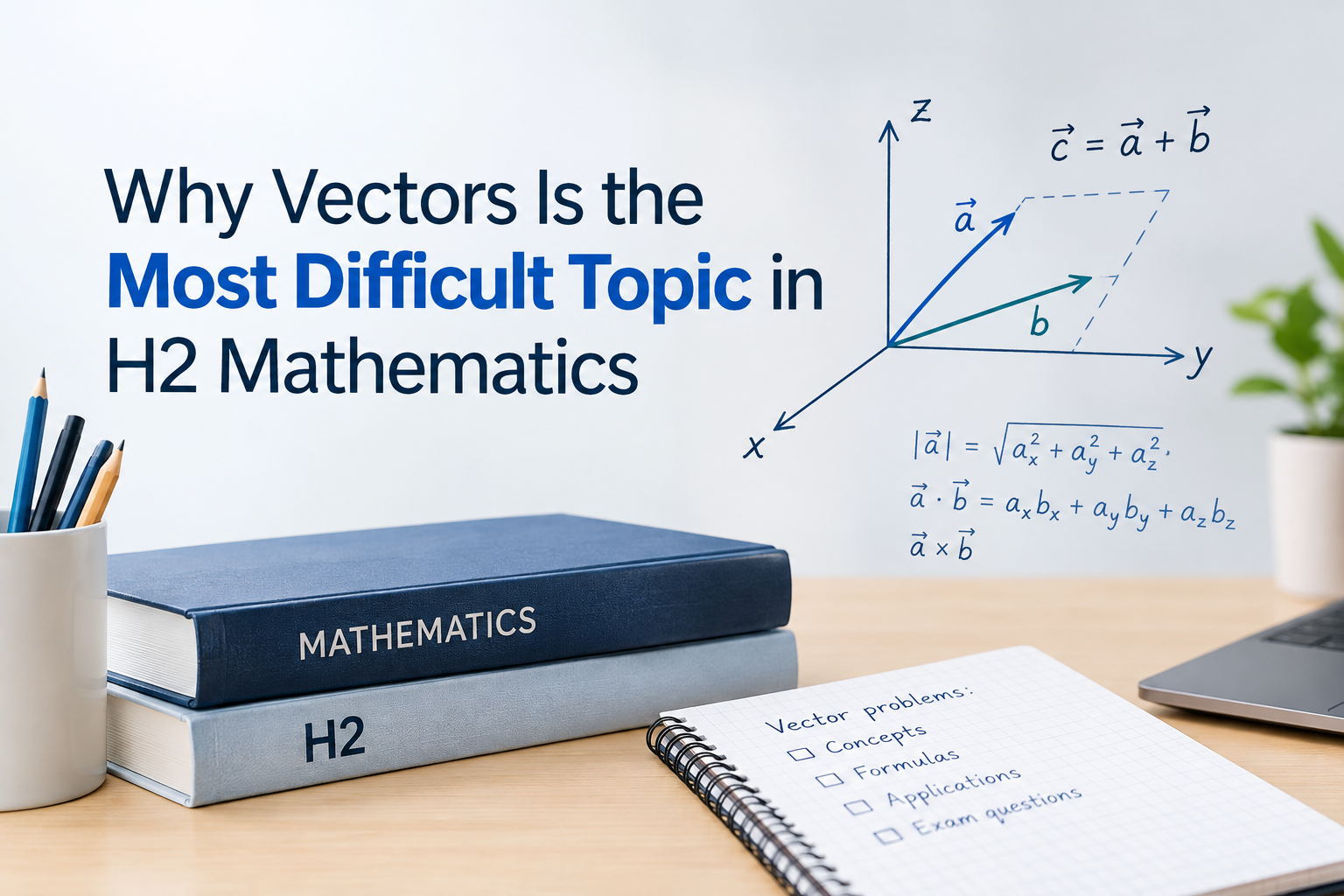
Why Vectors Is the Most Difficult Topic in H2 Mathematics
If you ask my H2 Math students which topic they find the most difficult, I would not be surprised if many of them give me the same answer.
Vectors.
In fact, vectors is probably the topic I hear students complain about most often.
And I can understand why.
Vectors is already introduced in Secondary 4 E Math, and even then, many students find it difficult. But in E Math, vectors is a relatively small topic.
When students move on to H2 Mathematics in JC, vectors becomes a much bigger and more important part of the syllabus. It is also a topic where the concepts become increasingly abstract, and each new concept builds upon what came before.
For students who did not fully understand the foundations, this can become a very difficult journey.
Why Is Vectors So Difficult?
To understand why students struggle with vectors, we first need to understand what makes vectors different from the mathematics they are already familiar with.
Most of the quantities students deal with in Mathematics have magnitude only.
For example, students are used to working with numbers such as 2 and -2. Even though the negative sign introduces direction along a number line, it is still relatively familiar.
But a vector has both magnitude and direction.
This is a new way of thinking.
Students are no longer simply manipulating numbers. They have to think about where something is going as well as how much of it there is.
That is why even something as basic as adding or subtracting vectors can be difficult for a student who is new to the topic.
It is not always easy to visualise what is happening.
And visualisation is extremely important in vectors.
In H2 Math, Vectors Becomes a Major Topic
The difficulty increases significantly when students move from E Math to H2 Mathematics.
In H2 Math, vectors is no longer just one small topic. It becomes a substantial part of the syllabus and can account for approximately 10–15% of the H2 Mathematics examination.
There are many concepts to learn, and these concepts are not isolated. They build upon one another.
This is one of the reasons I spend around eight lessons teaching vectors to my students.
Eight lessons may sound like a long time to spend on one topic, but I believe it is necessary.
If a student does not understand an early concept properly, the problem does not simply remain in that chapter. It follows them into the next one, because the subsequent concepts build upon what came before.
Before long, the student may find himself looking at a later chapter and thinking:
“I don’t understand any of this.”
The real problem may have started several chapters earlier.
The Concepts Become Increasingly Abstract
As students progress through vectors, the mathematics becomes more abstract.
We have the scalar product and cross product of vectors. In very simple terms, you can think of these as forms of multiplication involving vectors.
But unlike ordinary multiplication, there are specific definitions, rules and interpretations to understand.
The direction of the resulting vector from cross product matters.
From these ideas, students then move on to concepts such as finding normals to a plane.
Then there is another major part of the topic involving lines and planes.
Students learn to express equations of lines in vector form. They then encounter planes — not an aeroplane, of course, but a two-dimensional surface — which can also be described using vectors.
By this stage, questions can combine several different ideas.
This is where students who have not built a strong foundation can become completely lost.
A Long Vector Question Is Really Made Up of Smaller Ideas
One thing I try very hard to show my students is that a long vectors question is usually not one enormous, mysterious problem.
It may look that way.
A 10-mark or 15-mark question may contain a complicated context involving distances, lines and planes. A student may look at the entire question and think:
“I don’t know what to do.”
But when we break it down, the question is often made up of several smaller concepts that the student already knows.
For example, imagine a question involving a person and a railway track. It may sound complicated because of the context, but mathematically, it could simply be asking for the distance between a point and a line.
There is a method.
I teach the students the method.
This is not something I want students to simply memorise as a formula. I want them to understand where the formula comes from.
Why I Make My Students Draw
Because vectors involve direction, I draw a lot.
And I get my students to draw too.
But there is a reason for this.
I do not want students to blindly memorise a sequence of steps. I want the diagram to help them remember what to do next.
For example, if we want to find the distance between a point and a plane, I ask students to draw the situation.
Then we draw the right-angled triangle.
Once they can see the triangle, they can connect it to the trigonometry they already know.
From there, they can understand how the formula for the distance between a point and a plane is obtained.
The formula is no longer something they simply have to remember.
The diagram helps them reconstruct the method.
This is particularly useful when they encounter an unfamiliar examination question. Instead of trying to recall a memorised sequence, they can draw the situation, identify what is happening and work out the next step.
That is a much more powerful form of understanding.
I Build Vectors From the Ground Up
This is why I do not like to simply “revise” vectors with a student who has never properly understood the topic.
Sometimes, a few revision sessions are enough.
But very often, they are not.
Many students who join my H2 Math Tuition Singapore classes tell me that they struggled with vectors at school or at another tuition centre.
Sometimes they have already been through the topic once.
Sometimes they have attempted revision.
But the difficulty is still there.
In these situations, I often find that the student needs to relearn vectors from the beginning.
Not because the student is weak.
Rather, the foundations were never properly established.
So in my eight lessons on vectors, I go through the topic systematically from scratch.
I make sure students understand what is happening at every stage.
There should be no unexplained gaps between the concepts.
Chapter by chapter, we build.
Concept by concept, we connect.
By the time we reach planes, students should be able to see how the ideas they learnt much earlier have led them there.
My Goal Is for Students to Stop Thinking That Vectors Is Difficult
One of the things I find most satisfying about teaching vectors is seeing students’ perception of the topic change.
Before going through my lessons, many students tell me that vectors is the hardest topic in H2 Math.
After going through the topic properly, they generally do not say that anymore.
The mathematics has not magically become easier.
They have simply understood it.
They now know what each concept means, how the concepts are connected and which method to use when they encounter a particular type of problem.
That confidence makes a huge difference.
I remember one student in particular who joined me for a re-teaching of vectors very close to his A-Levels.
He had scored a U grade for his JC2 prelim examination.
But he took the opportunity to relearn vectors properly through my lessons.
He grasped the topic extremely well.
At the A-Levels, he scored an A for H2 Mathematics.
In that particular year, vectors made up approximately 15% of the paper, so having confidence in vectors made a significant difference to him.
More importantly, I believe that the confidence he gained from finally understanding vectors also helped him approach the rest of the paper differently.
He no longer had to look at vectors and think:
“I can’t do this.”
He knew what to do.
Don’t Wait Until Vectors Becomes a Problem
This is perhaps the most important message I want to give parents and students.
JC is only two years.
The period in which students build up the H2 Math syllabus is actually just a little more than one year before they have to start thinking seriously about revision and examinations.
That is not a very long time.
So I would not recommend waiting until a student is already struggling badly before seeking help.
By then, the problem may not be just vectors.
If the student has missed important foundations, later parts of the topic may also have become affected.
It is much better to learn the topic properly from the beginning.
This is why I encourage students looking for H2 Math Tuition Singapore to join early, particularly at the start of JC1.
The aim is not simply to have someone rescue you when you are already struggling.
The aim is to build the understanding properly in the first place.
Vectors Does Not Have to Remain Difficult
Vectors is difficult.
I am not going to pretend otherwise.
It is one of the most conceptually demanding topics in H2 Mathematics, and it requires time, visualisation and careful understanding.
But difficult does not mean impossible.
When students understand what vectors represent, learn to visualise them, and build each concept carefully upon the previous one, the topic becomes much more manageable.
A long 15-mark question no longer looks like one enormous problem.
The student begins to recognise the smaller pieces.
“This is asking for the distance between a point and a line.”
“This is asking for the foot of the perpendicular.”
“I know how to find the equation of a plane.”
And suddenly, the question becomes something they can tackle.
That is what I want my students to experience.
Not simply knowing how to reproduce a solution, but being able to look at a difficult vectors question and think:
“I know what is going on here. I know how to start.”
And perhaps that is the best measure of whether a student has truly learnt vectors.
Not that vectors has become easy.
But that it is no longer something they are afraid of.
Looking for H2 Math Tuition Singapore?
At Debbie’s Learning Cove, I teach H2 Mathematics with a strong emphasis on conceptual understanding and systematic problem-solving.
For vectors, I take students through the topic from the foundations upwards, using diagrams, examples and carefully sequenced concepts so that they can see how each part connects to the next.
My goal is not simply to help students get through one difficult topic. It is to help them understand the Mathematics well enough to approach unfamiliar questions with confidence and know where to begin.
If your child is already struggling with vectors, it may be time to ask whether they need more revision, or whether they need to relearn the topic properly from the beginning.