 September 8, 2026
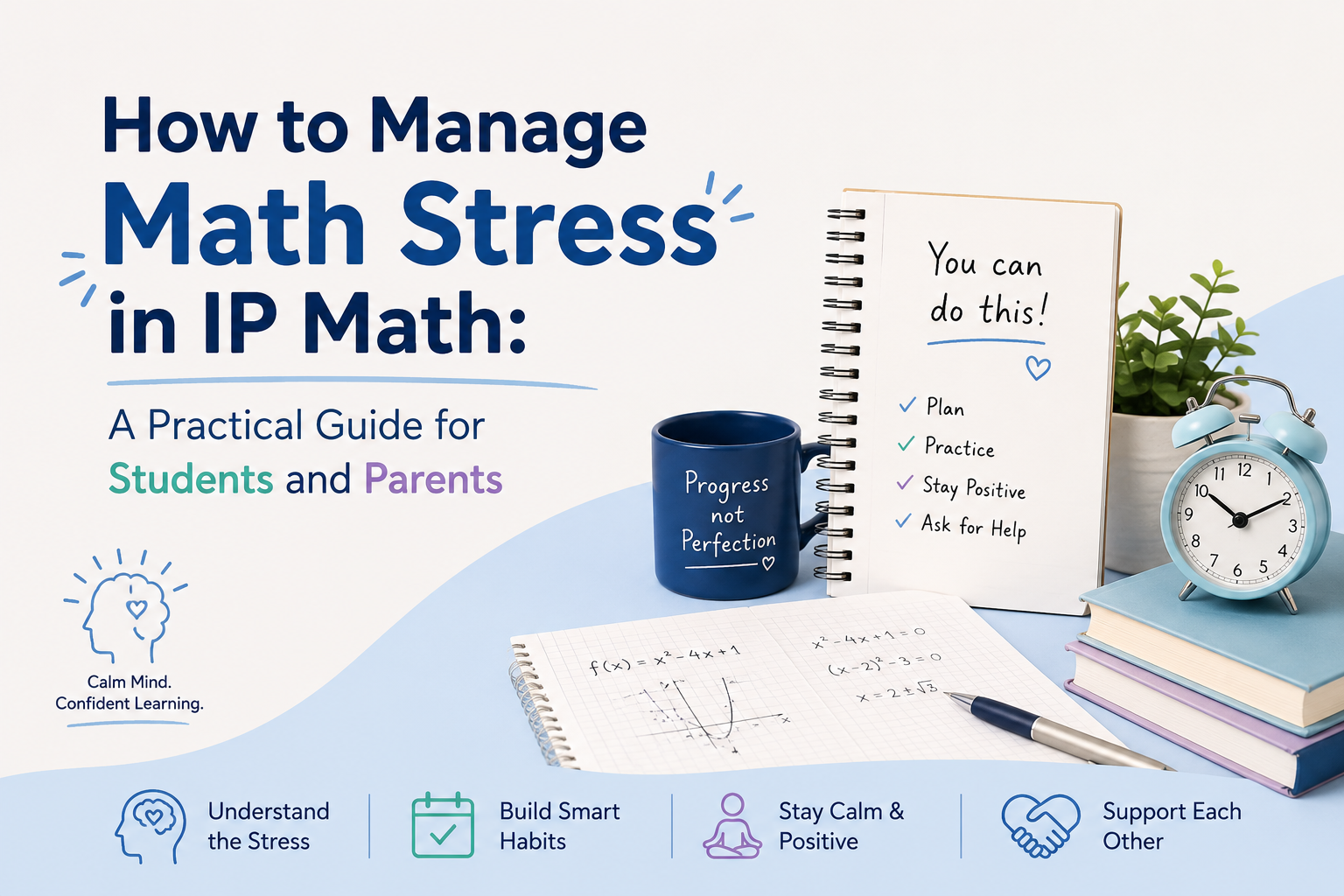
How to Manage Math Stress in IP Math: A Practical Guide for Students and Parents
When Math Stress Makes a Capable Student Feel Incapable
A student sits down to revise IP Math. She opens her school notes, looks at a page of unfamiliar algebra and suddenly feels that she understands nothing. One unfinished tutorial reminds her of two other chapters she has not revised. Very quickly, the problem is no longer one question. In her mind, it becomes: “I am behind. I am bad at Math. I will never catch up.”
This is how Math stress often grows. It does not always begin with a terrible examination result. Sometimes it begins with one concept that was not fully understood, one week of missed work, or one difficult worksheet. Once worry takes over, students may avoid the subject, work more slowly, or stare at questions without knowing where to begin. The avoidance then creates a larger backlog, which creates even more stress.
I have taught Mathematics for more than 25 years, including IP Mathematics, Additional Mathematics and A-Level Mathematics. One thing I have observed repeatedly is that feeling overwhelmed does not mean a student lacks ability. Many academically capable students become stressed precisely because they care deeply about doing well. They are used to understanding quickly, and when Mathematics stops coming easily, they interpret the struggle as failure.
It is not failure. It is a problem that can be broken down, understood and managed.
Why IP Math Can Feel Particularly Overwhelming
The Integrated Programme places greater emphasis on independent learning, exploration and mathematical reasoning. In school, a concept may be introduced through an activity, group discussion or investigation rather than explained directly from beginning to end. Students are often given a large bank of questions and are expected to schedule in their own practice.
This approach can be enriching for a self-directed student. However, not every capable teenager automatically knows how to organise revision, diagnose a misconception or select appropriate questions. Some students attend lessons, copy the solutions and appear to keep up, but their understanding is not yet secure. The difficulty only becomes obvious when a test requires them to apply the concept in an unfamiliar way.
From my personal experience and observation, here’s some tips on how to manage Math Stress.
1. Treat the Problem as Temporary, Not as Your Identity
A bad week in Mathematics is not a verdict on your intelligence. A low mark is information. It tells you that certain concepts, methods or examination habits need attention. It does not tell you that you are permanently “not a Math person”.
When students tell themselves, “I always fail Math,” they turn a specific problem into a fixed identity. A more useful statement is: “I do not understand this topic yet.” The word “yet” matters. It leaves room for action.
Mathematics is unusually encouraging in this respect. Once a concept is properly understood, that understanding tends to stay with you. The confusion before understanding may feel endless, but the breakthrough can happen quickly when the correct explanation is given that helps you see the light.
2. Reduce the Size of the Problem
When students are stressed, they often make the task frighteningly large: “I must revise the whole chapter,” “I am behind in the entire semester,” or “I need to finish all the worksheets this weekend.” A plan this large creates panic before revision even begins.
Break the work into a unit small enough to complete. Instead of revising one entire difficult chapter, revise two pages of notes, one subtopic or five carefully selected questions. The aim is not to create an impressive schedule. The aim is to restart movement.
I often tell myself that as long as I end the day knowing a little more than I knew yesterday, I am good. That may sound modest, but steady progress is how strong understanding is built. Ten small sessions completed are far more valuable than one heroic revision plan that is abandoned after two days.
A useful daily target might be: review one concept, redo two worked examples without looking, complete three basic questions and write down one doubt to clarify.
3. Begin With Questions You Can Manage
A stressed student should not begin revision with the most intimidating question on the page. That is like trying to sprint before warming up. Start with questions that test the basic idea, then move gradually towards more complex and less structured problems.
This progression is central to how I design worksheets at Debbie’s Learning Cove. Questions begin in a structured way so that students can understand the method and experience success. The scaffolding is gradually removed. Only after the foundation is stable do students tackle the open-ended and higher-order questions commonly found in IP examinations.
This is not “making Math easy” in a superficial sense. It is making the learning sequence intelligent. Throwing a student straight into the deepest end may create fear, but fear is not the same as productive challenge.
4. Ask Precise Questions and Get Precise Help
Many students say, “I do not understand the whole chapter.” Usually, that is not literally true. They may understand the formula but not know when to use it. They may follow a worked example but become stuck with one particular line of working.
Try to identify the exact point of confusion. For example: “How did this line of working come about?” “Why is my method not acceptable?” “How do I apply the formula for this question?” Precise questions lead to precise explanations.
Asking for help is not a sign that independent learning has failed. Genuine independent learning includes knowing when to consult a teacher, compare methods with peers or seek feedback. The goal is not to struggle alone. The goal is to become capable of learning independently with the resources available for you.
5. Create Temporary Whitespace
Sometimes the most responsible response to stress is to make temporary space for the problem that matters most. That may mean declining one social outing, reducing a non-essential commitment for a week, or setting aside a quiet block of time without your phone.
When I was in junior college, I once gave up Chinese New Year visitations so that I could catch up on my Mathematics tutorials. I am not suggesting that students should constantly sacrifice family time or live without rest. The point is that a temporary adjustment can be sensible when work has accumulated and the worry is following you everywhere.
There is little enjoyment in meeting friends while feeling guilty about the untouched work at home. Sometimes completing the pressing task first allows you to return to normal life with a much lighter mind. The key word is temporary. Do not remove every enjoyable activity. Rest, exercise and friendships are also part of staying well.
6. Replace Repeated Rereading With Active Revision
A student can spend two hours looking at notes and still feel unprepared. Passive rereading feels safe because it avoids the discomfort of testing yourself. Unfortunately, it can also create the illusion that you understand more than you do.
After reviewing an explanation, close the notes and attempt the method independently. Redo a worked example without copying. Explain aloud why each step is valid. Mark the question and identify whether the error came from concept, algebra, careless work or interpretation.
For IP Math, revision must include both understanding and application. Students need enough structured practice for the method to become secure, followed by unfamiliar questions that require them to decide on a strategy. This is why revision matters even after the syllabus has been covered. Coverage tells you that a topic has been taught. Revision tells you whether it can be used.
7. Parents: Provide Calm Support, Not More Pressure
When a child is stressed about Math, a parent’s first instinct may be to ask more questions: “Have you finished your work?” “Why did you not ask your teacher?” “How many marks did your friend get?” These questions may come from concern, but a worried teenager can hear them as further evidence that something is terribly wrong.
Parents do not need to become substitute Math teachers. Often, the most helpful role is background support: help the child protect a regular study period, provide a quiet place to work, encourage sleep and meals, and listen before offering a solution.
Instead of focusing only on the next grade, notice the behaviour that leads to improvement: starting revision earlier, completing practice, returning to a difficult question and asking for help. Confidence grows when students see that their actions can change the outcome.
When IP Math Tuition Can Reduce Stress
Tuition should not become another source of worksheets, rushing and anxiety. Good IP Math tuition should reduce the amount of confused, unproductive time a student spends alone.
At Debbie’s Learning Cove, I teach concepts from first principles before introducing efficient problem-solving techniques. I use graphs, visual explanations, memorable actions, acronyms and humour to make abstract ideas easier to understand and retain. Students receive carefully structured notes and worksheets that progress from fundamental questions to the non-routine problems expected in IP examinations.
My aim is not merely to help students survive the next school test. IP Years 3 and 4 provide an important foundation for H2 Mathematics. Students who memorise methods without understanding may manage familiar secondary-level questions but struggle when the same ideas are assumed at junior college. A strong conceptual foundation reduces present stress and prevents future gaps.
Over the years, students have often told me that a topic seemed much easier after it was clearly explained. That is exactly what effective teaching should do. It should not remove challenge, but it should remove unnecessary confusion.
A Difficult Period in Math Can Become a Turning Point
I have seen students move from fear and discouragement to confidence, strong grades and even genuine enjoyment of Mathematics. The turning point is rarely one magical study trick. It is usually a combination of clearer teaching, appropriately sequenced practice, honest correction of gaps and consistent revision.
So when IP Math feels overwhelming, do not demand that you conquer everything immediately. Identify the next concept. Complete the next manageable set of questions. Ask the next precise question. Then repeat.
You do not have to feel confident before you begin. Very often, confidence comes after you have begun and can finally see yourself making progress.
Need structured support for IP Math?
Debbie’s Learning Cove offers live IP Math tuition in Singapore for students on the A-Level pathway. Lessons are taught personally by Mrs Debbie Wong and focus on clear conceptual understanding, carefully sequenced practice and a strong foundation for H2 Mathematics.
Contact us to enquire about a trial lesson or suitable class placement.
Enquire About IP Math Tuition
Frequently Asked Questions
Is it normal for a capable IP student to feel stressed about Math?
Yes. IP students are academically capable, but capability does not automatically provide revision skills, confidence or complete conceptual understanding. Stress often appears when small gaps accumulate or when students compare themselves with high-performing classmates.
How can an IP student catch up after falling behind?
Begin by listing the topics that are unclear, then prioritise the foundational ones. Revise one small section at a time, practise basic questions before advanced ones, and seek help for specific doubts. A structured catch-up plan is more effective than attempting every unfinished worksheet at once.
When should parents consider IP Math tuition in Singapore?
Consider additional support when a child repeatedly cannot follow school lessons, spends excessive time on homework, avoids Math, loses confidence or continues to underperform despite effort. It is usually easier to correct gaps early than after several topics have accumulated.
Does an IP Math tuition class need to cater exclusively to one IP school?
Not necessarily. Each IP school may arrange topics differently, but the core Advanced Mathematics content is largely shared. Strong teaching of these core concepts, together with preparation for higher-order questions, can support students from different IP schools.
How can parents help without increasing Math stress?
Stay calm, avoid comparisons and focus on practical support. Encourage a regular study routine, sufficient rest and early clarification of doubts. Praise consistent effort and progress, not only the final score.