 September 14, 2026
Why I Don’t Want My A Math Students to Simply Memorise Differentiation
There is a point in Secondary 4 Additional Mathematics when many students begin to feel rather pleased with themselves.
They have learnt differentiation.
They know that if then . They have learnt the chain rule, product rule and quotient rule. Give them an expression and ask them to differentiate it, and many can confidently fill half a page with working.
Then I give them an application question.
Suddenly, the confidence disappears.
“Mrs Wong, what do I do?”
This is one of the reasons I enjoy teaching calculus so much. Differentiation exposes an important difference between knowing a mathematical technique and actually understanding Mathematics.
After more than 25 years of teaching Mathematics, I have become increasingly convinced that students should not be satisfied simply because they can reproduce a method. My goal in A Math Tuition is to help students understand what they are doing, recognise when a technique is useful and eventually become confident enough to handle questions that do not look exactly like something they have seen before.
Differentiation Is Not Just About Finding dy/dx
When students first encounter differentiation, it is easy to think of it as another collection of formulas.
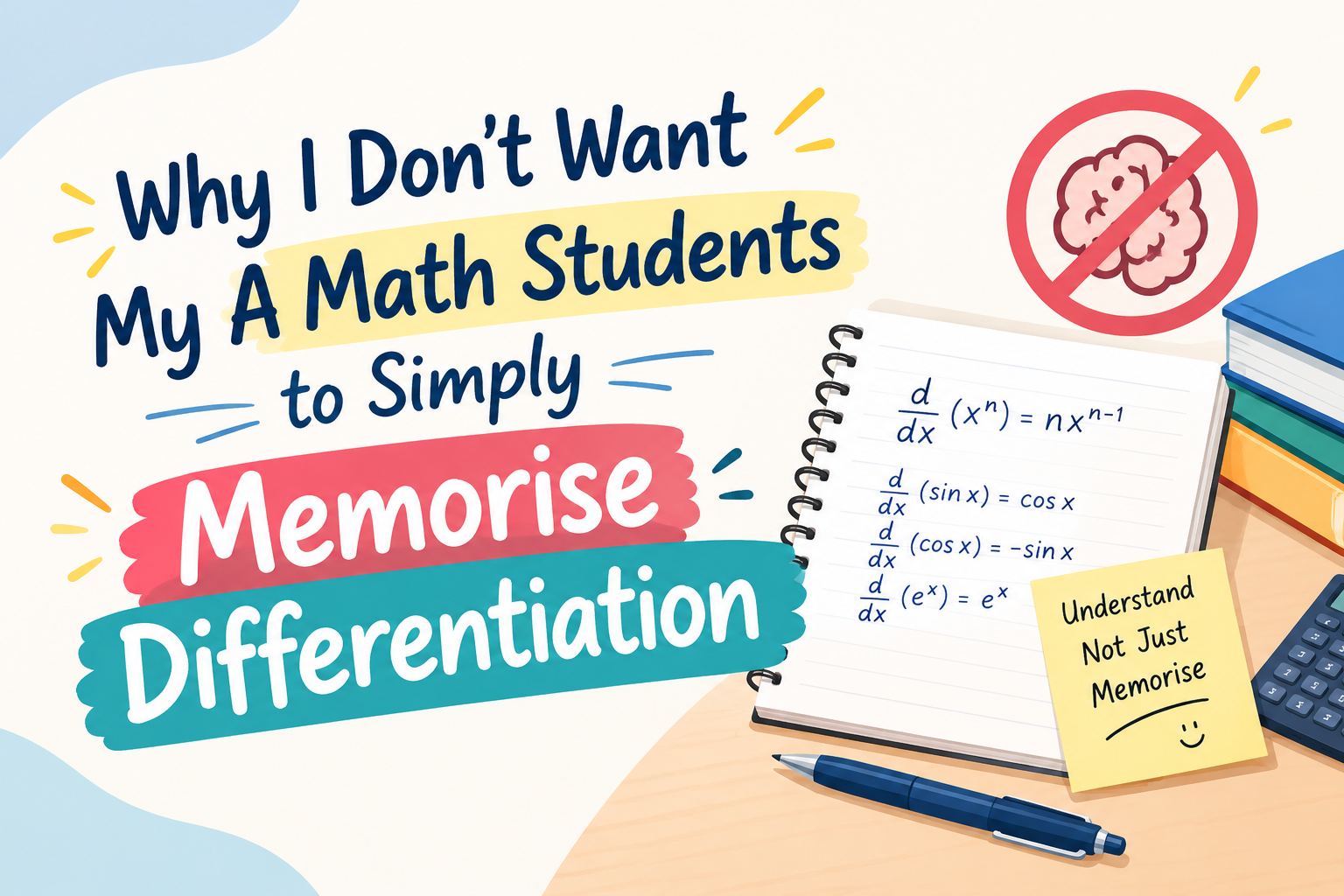
Differentiate (x^n). Differentiate (sin x). Differentiate (e^x). Apply the chain rule, product rule or quotient rule.
These techniques are certainly important, and my own calculus notes organise them systematically because students need a clear reference when learning and revising.
But the formulas are only the beginning.
Differentiation tells us something extremely useful: how one quantity is changing in relation to another.
Once students understand this, many seemingly separate parts of the A Math syllabus begin to connect.
Why does tell us that a function is increasing? Why do we differentiate when looking for a stationary point? Why is the gradient of a normal related to the gradient of a tangent?
These should not feel like unrelated facts to memorise. They are consequences of one central idea: the derivative represents a rate of change and, geometrically, the gradient of a curve at a particular point.
That is the big picture I want my students to see.
The Formula Is Often the Easy Part
Students sometimes assume that the hardest part of an A Math question is the algebra. Quite often, it isn’t.
The harder part is deciding what the question is really asking you to do.
Suppose a question tells you that a function is increasing. A student who has memorised differentiation formulas may still stare at the question wondering what to do.
A student who understands differentiation should make the connection:
Increasing function implies positive gradient which implies .
I think of this as the “translation” part of Mathematics. Examination questions are presented in words, diagrams and unfamiliar situations. Students must translate that information into Mathematics before they can solve anything.
Sometimes a Silly Story Helps
Over the years, I have developed all sorts of little explanations, actions and silly stories to help students remember mathematical processes.
I do this deliberately.
Mathematics is logical, but students are human.
If a ridiculous story helps a 15 or 16-year-old remember a process correctly under examination pressure, I am perfectly happy to use it.
For the quotient rule, for example, I use my “tired denominator” story. It is not sophisticated mathematics. It is simply a memory device that helps students remember the order correctly instead of reversing the numerator terms.
But there is an important distinction.
The memory device helps them remember the technique. It does not replace understanding.
That is how I use mnemonics in my Additional Math Tuition lessons.
Understand first. Make it memorable. Then practise until it becomes natural.
Students Need a Toolbox, Not a Collection of Chapters
Another difficulty with calculus is that examination questions do not announce which differentiation rule should be used.
A worksheet exercise might have the heading “Product Rule”.
The examination will not.
Students therefore need to look at an expression and recognise its mathematical structure. Is this a function inside another function? Are two functions being multiplied? Is one function divided by another? Often, more than one technique is required in the same expression.
This is where students who have learnt each rule in isolation can struggle.
Eventually, I want my students to see these techniques as tools in one toolbox rather than separate concepts in their notes.
Instead of asking:
“Which formula did Mrs Wong teach me for this type of question?”
I want them to ask:
“What mathematical structure am I looking at, and which tool is appropriate?”
That change in thinking is an important step towards mathematical maturity.
I Am Also Preparing Them for H2 Mathematics
There is another reason I am particular about conceptual understanding in A Math.
Secondary school is not the end of the journey for many of my students.
A strong foundation in Additional Mathematics is essential preparation for H2 Mathematics. Your A Math knowledge does not disappear when you enter JC. It is assumed.
At A Math level, students learn algebraic, trigonometric, exponential and logarithmic differentiation, together with the chain, product and quotient rules. They then apply differentiation to gradients, tangents, normals, stationary points and increasing or decreasing functions.
At H2 level, differentiation becomes significantly more sophisticated. Students meet additional techniques such as implicit differentiation and parametric differentiation, while applying familiar ideas in much more demanding questions.
A student who enters JC thinking, “I memorised the quotient rule and survived my O Levels,” may discover very quickly that survival is not the same as foundation.
That is why I sometimes teach an A Math idea slightly more deeply than is strictly necessary for the easiest examination question.
I am looking further ahead.
Does This Mean Students Shouldn’t Memorise Anything?
Absolutely not.
There are things students need to remember. An examination is not the time to derive every mathematical result from first principles.
Students need formulas, standard processes and familiar techniques readily available in their minds. Speed matters too.
My objection is not to memorisation.
My objection is to memorisation without understanding.
If a student understands a concept first and subsequently memorises the necessary formula through practice, excellent.
If a student has no idea what the Mathematics means but memorises a sequence of steps because “this type of question always do like that”, I become worried.
That strategy works until the question changes.
And examiners are rather good at changing the question.
Understanding Does Not Replace Practice
I am equally wary of the opposite misconception: that once students understand something, they no longer need much practice.
They do.
A lot of it.
You can understand how to swim perfectly while sitting beside a swimming pool. Eventually, you still have to get into the water.
The same applies to A Math.
Students need to practise until algebra becomes fluent, differentiation techniques become familiar and important connections can be recognised quickly.
My approach is therefore:
Understand → practise → apply → review mistakes → practise again.
The order matters.
Practice should reinforce understanding, not substitute for it.
This is also why my worksheets progress from more straightforward questions towards exam-level problems. Students first need to become comfortable with the machinery. Then I can challenge them to think.
One Wrong Answer Can Tell Me More Than Ten Correct Ones
When I walk around during practice time, I am not only interested in whether an answer is correct. I want to see how the student is thinking.
A wrong answer can be extremely informative.
Did the student choose the wrong rule? Did they understand the rule but make an algebraic mistake? Did they differentiate correctly but fail to interpret what the derivative means? Did they know that a stationary point requires but not understand why?
These are completely different problems.
Simply telling all these students, “Practise more differentiation,” would not be very useful.
Good Additional Math Tuition in Singapore should diagnose the misconception, not merely provide another pile of questions.
Sometimes one sentence of explanation fixes a mistake that twenty more questions would simply reinforce.
The Moment Mathematics Finally Clicks
One of my favourite moments as a teacher is not when a student gets a difficult answer correct.
It is the moment just before that.
You explain something from a slightly different angle. The student looks at the question again. There is a pause.
And then …
“Ohhh…”
Teachers know that sound very well.
That is the moment I teach for.
Once students genuinely understand an idea, Mathematics becomes much less frightening. Questions stop looking like an endless collection of unrelated tricks. Patterns emerge. Concepts connect.
And gradually, the student stops asking:
“What formula do I use?”
Instead, they begin asking the much better question:
“What is happening mathematically?”
A Math Can Become One of Your Child’s Strongest Subjects
I have taught students who initially struggled badly with Additional Mathematics and later achieved distinctions.
One student joined after obtaining a C5 for her Secondary 3 year-end examination. Within one semester, her A Math improved to an A1, and she described A Math as having become one of her best subjects. Another student improved from B3 to A1 and later continued with H2 Mathematics.
These transformations are rewarding, but I don’t believe there is a magic trick behind them.
Usually, the process is much less dramatic.
Understand one concept properly.
Fix one misconception.
Practise.
Become a little more confident.
Then move on to the next concept.
Over time, those small improvements compound.
That is why I tell students that Additional Mathematics does not have to remain the subject they fear. Once the concepts begin to make sense, A Math can actually become one of the most satisfying subjects to learn.
And differentiation is a wonderful place to discover that.
Because the real achievement is not being able to recite the quotient rule perfectly.
It is reaching the point where you understand why you are differentiating in the first place.
Looking for Additional Math Tuition in Singapore?
At Debbie’s Learning Cove, my A Math Tuition lessons focus on clear conceptual understanding, systematic problem-solving and carefully structured practice. Students are taught personally by me, with concise notes and worksheets designed to help them understand difficult ideas and prepare confidently for their examinations.
If your child understands basic techniques but struggles when questions become unfamiliar, this is exactly the kind of gap that should be addressed early.
The aim is not simply to get through the next test.
It is to build a mathematical foundation strong enough to take your child through the O Level or SEC examinations and, for those continuing to junior college, into H2 Mathematics and beyond.