 October 28, 2026
Why the Same Tuition Doesn’t Work for Every Child
When parents start looking for tuition for their child, one of the first questions they often ask is:
“Should I choose group tuition or one-to-one tuition?”
There is no simple answer.
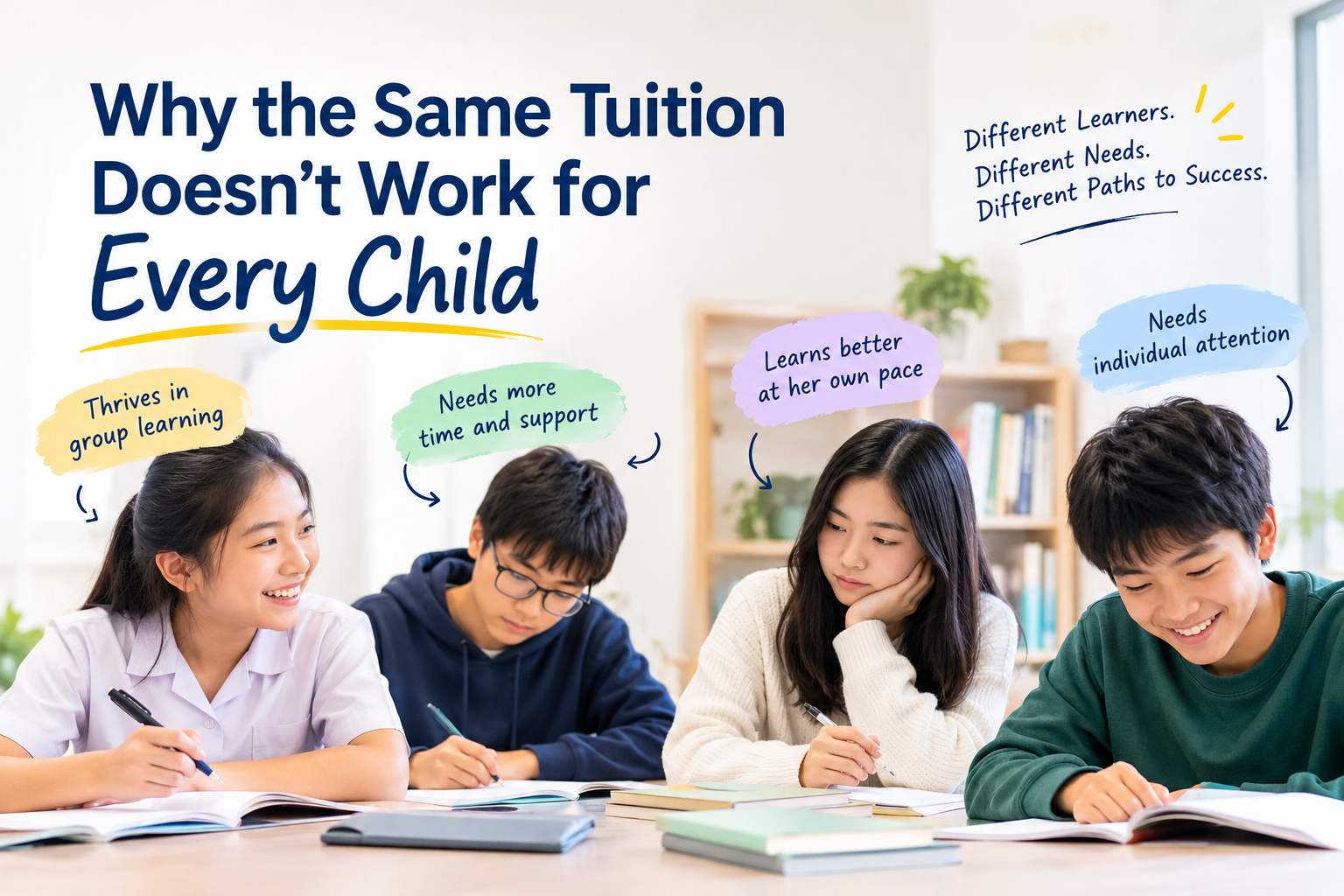
After more than 25 years of teaching Mathematics, I have seen students thrive in very different learning environments. Some children flourish in a group classroom. They enjoy having classmates around them, respond well to a teacher-led lesson and are motivated by seeing their peers working hard.
Others need a much more personalised environment. They may need concepts explained more slowly, more opportunities to ask questions, or more individual attention before they can gain confidence.
And sometimes, the tuition arrangement that works beautifully for one child in the family may be completely unsuitable for another.
I know this not only as a teacher, but also as a parent.
My Two Children Taught Me an Important Lesson
My children are now between 18 and 21 years old, and looking back, I realise that I made a very natural assumption when they were younger.
My older daughter did very well in a group learning environment.
She was attentive and able to absorb information from a teacher-led lesson. She was also slightly competitive by nature. If the students around her were working quickly, she wanted to keep up. If everyone was focused, she was focused too.
The classroom environment worked for her.
She was comfortable learning alongside her peers, and she went on to do very well in her A-Level examinations.
So naturally, when it came to my younger son, I thought the same approach would work.
I was wrong.
My son struggled to keep up with the pace expected in a group tuition setting. After a while, he would drift off and lose focus. The pace of the lesson became a challenge rather than something that motivated him.
Eventually, I decided that one-to-one tuition would be more suitable for him, and we switched him to individual tuition for his subjects.
Interestingly, some of his one-to-one tutors were undergraduates rather than experienced, professionally trained teachers. Yet the arrangement benefited him more because the pace could be slowed down and the work could be explained according to his needs.
That experience taught me something that I have also observed repeatedly throughout my teaching career:
There is no universally “best” type of tuition. There is only tuition that is more or less suitable for a particular child.
And this is something I believe parents should think about before they even start comparing tuition centres.
How to Choose the Right Tuition for Your Child
It is very easy to ask:
“Which tuition centre is the best?”
But perhaps the more useful question is:
“What kind of learner is my child?”
This matters because children are motivated by different things.
Some children are naturally competitive. They see their classmates completing questions and think, I want to do that too.
Some children are motivated by the teacher. They enjoy listening, absorbing information and following a structured lesson.
Some need the presence of peers to keep them focused.
Others become distracted when there are too many things happening around them.
Some children are perfectly comfortable raising their hands and asking questions in a group. Others would rather remain quiet even when they do not understand.
And some children need time.
They may understand a concept perfectly well if it is explained slowly, but struggle when they are expected to process new information at the same pace as everyone else.
None of these makes a child “better” or “worse” at learning.
It simply means that children learn differently.
Before deciding on tuition, parents should therefore consider their child’s ability, learning habits, attention span, confidence, motivation and personality—not just their grades.
This is particularly important when choosing Maths Tuition Singapore, as students have different learning needs and may respond differently to group lessons and individual attention.
Group Tuition: More Than Just a Cheaper Option
Group tuition is sometimes viewed simply as the more economical alternative to one-to-one tuition.
Cost is certainly one advantage. But there is much more to group tuition than that.
A well-run small group provides a classroom environment where students learn alongside their peers.
For the right child, this can be extremely effective.
Peers can create a healthy sense of accountability. When everyone around the child is attentive, working and participating, the child is more likely to stay on task too.
There can also be a positive competitive element.
A student who sees classmates completing their work may feel motivated to push themselves a little harder.
Group tuition also tends to provide a structured programme. Good tuition centres invest considerable effort in preparing lesson materials, planning the sequence of topics and designing questions that allow students to build their understanding progressively.
This structure can be particularly helpful for students who work well with a clear pace and routine.
However, group tuition does have limitations.
The teacher has a group of students to attend to. While a good teacher will monitor the class carefully, there is naturally less opportunity to spend extended one-to-one time with each student.
A student’s individual working may also not always be examined in the same depth as it would be in an individual lesson.
For a child who is significantly behind, has particular learning difficulties or requires a slower pace, this may become an issue.
One-to-One Tuition: Personalised, But Not Automatically Better
The biggest strength of one-to-one tuition is obvious: personalisation.
The tutor can focus entirely on the child.
If the student does not understand a particular concept, more time can be spent on it. If they are already confident, the tutor can move on. If there is a particular weakness that needs attention, the lesson can be tailored accordingly.
For a child who struggles to concentrate in a group, this can make a significant difference.
This was exactly what I saw with my own son.
But there is another side to one-to-one tuition that parents should consider.
The pace can become the child’s pace.
One parent once told me that this was precisely why she preferred group tuition for her child.
If a student is slow, unmotivated or has not completed their homework, an individual lesson can sometimes turn into a long session of sitting beside the student while they work through questions one at a time.
The tutor is giving individual attention, but the amount of work covered may be much less.
This is particularly important for students preparing for major examinations, where there is a substantial syllabus to cover.
There is also a considerable difference between a tutor who helps a student with questions and a teacher who can actually teach the subject.
Some one-to-one tutors are undergraduates or relatively young tutors who were good students themselves. They may be able to guide a student through questions successfully. But they may not know how to teach the concept to the child.
Sometimes, the child needs to be taught the concept in order to understand it and then apply it to questions.
An experienced teacher knows how to recognise misconceptions, identify gaps in foundations, explain the same concept in different ways and know what the student needs to understand before moving on.
For higher-level subjects such as H2 Math and JC Math, this distinction can become particularly important.
And naturally, a highly experienced teacher who provides this level of personalised teaching is likely to cost considerably more.
What About the Child Who Does Not Want One-to-One?
Interestingly, not every child wants individual tuition.
Some students actually tell me that they prefer learning in a group because they do not want to feel that all the attention is on them.
In a one-to-one lesson, there is nowhere to hide.
Every question is directed at them. Their working is visible. If they are struggling, the tutor knows immediately.
For some children, that is exactly what they need.
For others, it creates pressure.
They may feel more comfortable having classmates around them. They enjoy the atmosphere of learning together and do not want tuition to feel like another adult constantly watching them work.
Again, neither preference is wrong.
The question is whether the environment helps that particular child learn.
What Parents Should Look For
So before choosing between group tuition and one-to-one tuition, I would encourage parents to look at their child honestly.
Ask yourself:
- Does my child concentrate better when other students are around?
- Does friendly competition motivate them?
- Do they respond well to a teacher-led lesson?
- Can they keep up with the pace of a group?
- Do they need concepts explained several times?
- Are they comfortable asking questions in front of others?
- Do they become easily distracted?
- Do they need someone to slow down and guide them?
- Does individual attention make them feel supported or pressured?
- Is their difficulty caused by a lack of understanding, lack of practice, lack of motivation or a combination of these?
These questions can tell you much more about the kind of tuition your child needs than simply looking at which tuition centre is the most popular.
When comparing Maths Tuition Singapore options, parents should also consider the teacher’s experience, teaching approach, lesson structure and ability to identify gaps in a student’s understanding.
The aim is not simply to find more lessons for your child. It is to find an environment where they can learn effectively and make steady progress.
What I Have Learned as a Parent and Teacher
My experience with my own children reinforced something I had already seen many times in the classroom.
Two children can receive exactly the same teaching and respond completely differently.
As a teacher, I have students who are highly engaged in a group environment and students who need more individual attention.
I have students who respond very well to a fast-paced lesson and others who need concepts broken down carefully before they are ready to move on.
This is why, at Debbie’s Learning Cove, I place great importance on understanding how students think, not simply on getting through the syllabus.
For students taking H2 Math, A Math and IP Math, understanding is particularly important. Mathematics is cumulative. A student who has a gap in one concept may find that the same gap causes problems several chapters later.
Good Mathematics tuition should therefore do more than give students more questions to practise.
It should help them understand the concepts, identify their mistakes, strengthen their foundations and gradually develop the confidence to solve problems independently.
That is the kind of teaching I have spent more than 25 years developing.
You Don’t Have to Get It Right the First Time
Perhaps the most important thing I want parents to take away from my experience is this:
It is okay to get it wrong.
I got it wrong with my own son.
I assumed that because group tuition worked so well for my daughter, it would naturally work for him too.
It didn’t.
What mattered was recognising it, listening to him and changing the approach.
Parents sometimes feel that once they have chosen a tuition centre or tutor, they have to stick with the decision.
You don’t.
Talk to your child.
Talk to the tutor.
Observe what is happening.
And be willing to adjust.
The Right Tuition Is the Right Fit
There is no gold standard when it comes to tuition.
Group tuition is not automatically better than one-to-one tuition.
One-to-one tuition is not automatically better than group tuition.
A highly qualified tutor is not necessarily the right tutor for every child either.
The best tuition is the tuition that fits the child.
For one child, that may be a structured group classroom with good materials, a clear pace and motivated peers.
For another, it may be individual tuition where concepts can be slowed down, revisited and explained in a more personalised way.
As parents, we naturally want to make the best choices for our children. But sometimes the best thing we can do is to stop asking, “What is best?” and start asking:
“What is best for my child?”
That small change in perspective can make a very big difference.
Because ultimately, tuition is not about finding the most impressive programme.
It is about finding the learning environment in which your child can learn best.
If you are exploring Maths Tuition Singapore options for your child, take the time to understand their learning needs and the kind of teaching that will help them build confidence and develop a stronger understanding of Mathematics.
At Debbie’s Learning Cove, Debbie Wong draws on more than 25 years of teaching experience to help students strengthen their foundations, address misconceptions and develop independent problem-solving skills.
Looking for the right Mathematics tuition for your child? Visit Debbie’s Learning Cove to learn more and explore how the right learning approach can support your child’s progress.