 September 2, 2026
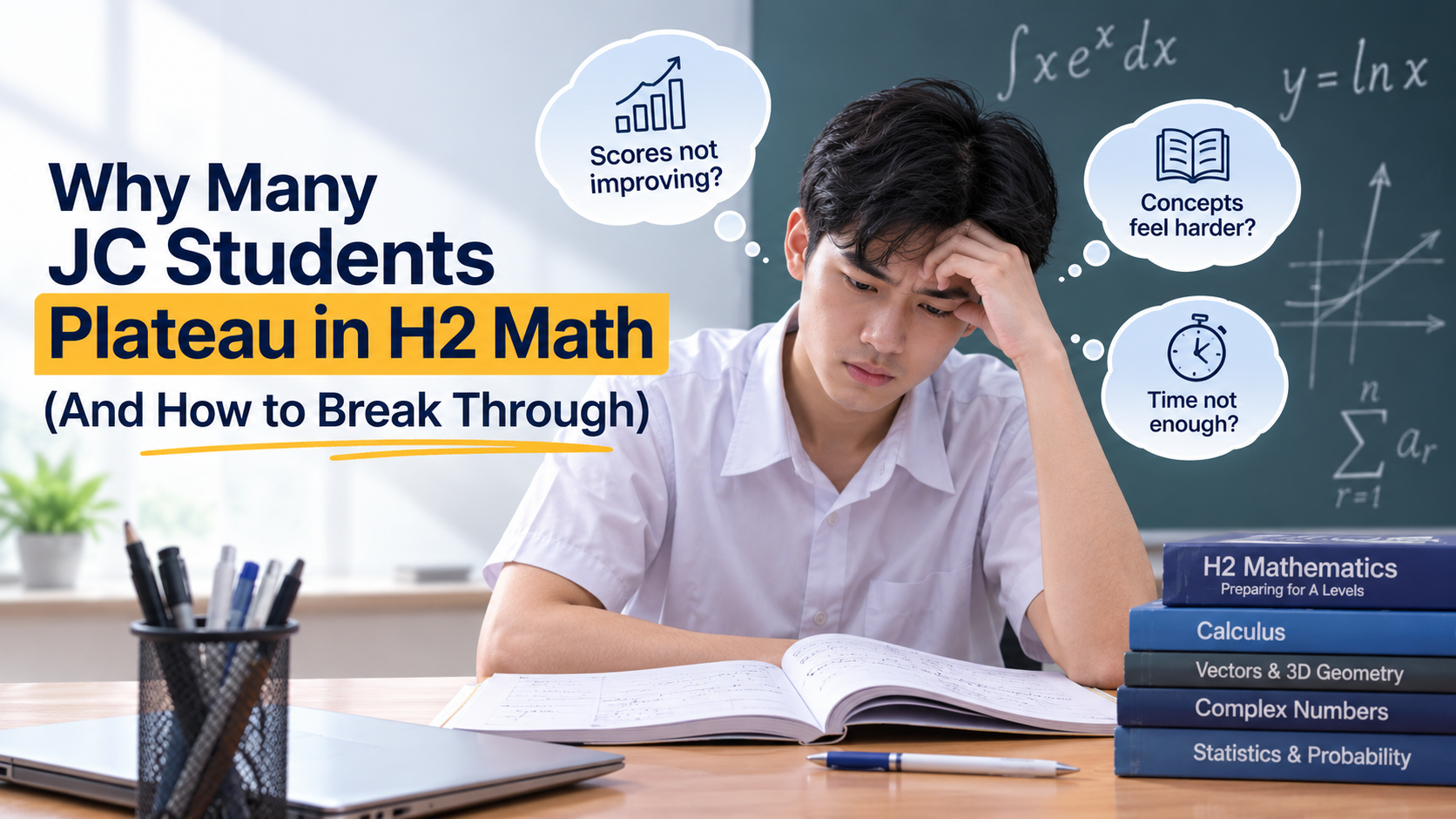
Why Many JC Students Plateau in H2 Math (And How to Break Through)
Many JC students begin JC1 with good intentions. They attend lectures, complete tutorials and even spend hours revising. Yet at some point, many feel frustrated.
“I’m studying harder than before, so why are my grades not improving?”
If this sounds familiar, you are not alone.
After teaching H2 Mathematics for over 25 years, I have noticed that many students eventually reach a plateau. They continue putting in effort, but their results remain stuck.
The good news is that this plateau can usually be overcome once students understand what is holding them back. The right H2 Math Tuition Singapore programme can also help students identify gaps in their understanding and develop stronger problem-solving skills.
Plateauing Is More Common Than Parents Think
Parents often assume that more practice naturally leads to better results.
Unfortunately, H2 Mathematics does not always work this way.
Unlike many O-Level subjects, H2 Mathematics requires students to combine multiple concepts within a single question. Questions are less predictable, and students need to decide which techniques to use rather than simply applying a memorised method.
This means students can spend many hours trying to do questions, without actually improving.
For this reason, effective JC H2 Math Tuition should focus not only on completing more questions, but also on developing independent thinking and conceptual understanding.
The Biggest Mistake: Mistaking Activity for Progress
Many students believe they are revising because they are:
-
Reading through lecture notes
-
Watching solution videos
-
Making their own summary notes
-
Looking through worked solutions
These activities feel productive because they are comfortable.
However, they do not necessarily improve problem-solving ability.
Real improvement only happens when students attempt difficult questions independently before looking at any solution.
This is often where the learning takes place.
Why Simply Going Through Questions Is Not Enough
One concern I occasionally hear from new students is that they previously attended lessons where the tutor simply demonstrated solving question after question.
While watching someone solve Mathematics problems can be useful, it is not the same as learning to solve them yourself.
Students need time to think.
They need opportunities to struggle.
They need to make mistakes.
Only then can misconceptions be identified and corrected.
Otherwise, it is easy to leave a lesson feeling confident, only to realise during an examination that the questions cannot be solved independently.
This is why a good H2 Math Tuition Singapore approach should give students opportunities to attempt problems themselves before receiving guidance.
Understanding Comes Before Speed
Many students become anxious because they compare themselves with classmates who appear to solve questions much faster.
However, speed is rarely the first goal.
Strong mathematicians first develop a deep understanding of concepts.
Once understanding becomes secure, speed naturally follows through repeated practice.
Trying to increase speed before understanding usually results in careless mistakes and unnecessary stress.
Every Mistake Is Giving You Information
One habit I encourage my students to develop is viewing mistakes differently.
Instead of asking:
“Why did I get this wrong?”
Ask:
“What exactly does this mistake tell me about my understanding?”
Sometimes the issue is algebra.
Sometimes it is not reading the question carefully.
Sometimes it is choosing the wrong method.
Sometimes it is simply missing a hidden assumption.
Every mistake provides valuable feedback that helps students improve.
Learning Mathematics Should Not Feel Like Memorising Recipes
One of the biggest differences between stronger and weaker students is flexibility.
Weaker students often try to memorise dozens of solving methods.
Stronger students focus on understanding the underlying mathematical ideas.
This allows them to adapt when unfamiliar questions appear in examinations.
A-Level examiners deliberately introduce questions that look different from previous years.
Students who rely only on memorisation often struggle.
Students who truly understand the mathematics usually adapt much more confidently.
Revision Is Where Real Improvement Happens
Many parents believe tuition ends once the syllabus has been completed.
In reality, this is often when the most important phase begins.
Completing the syllabus simply gives students the tools.
Revision teaches them how to use those tools efficiently.
During revision, students begin connecting topics that were previously learnt months apart.
Functions link with calculus.
Vectors combine with geometry.
Statistics draws upon probability concepts.
These connections are exactly what many examination questions test.
This is why effective H2 Math Tuition Singapore should support students beyond simply completing the syllabus and help them connect concepts during revision.
Confidence Grows Through Small Wins
Students sometimes think confidence comes before success.
In reality, it is often the opposite.
Confidence grows after many small successes.
Each correctly solved question strengthens belief.
Each misconception corrected reduces future mistakes.
Each difficult topic mastered makes the next challenge feel more manageable.
Progress is usually gradual rather than dramatic.
A Memorable Moment From My Classroom
Recently, after one of my H2 Mathematics lessons, a student stayed behind for a chat.
She told me she had been attending my lessons for about one and a half years and still looked forward to every class. She even said she wished she had joined earlier.
What surprised me most was that she wanted to introduce a friend from another tuition centre.
Her friend, she explained, usually spent lessons watching the tutor go through questions that students had never attempted beforehand. She felt that this approach was not helping her develop genuine problem-solving skills.
That conversation reminded me that students themselves often recognise the difference between passive learning and active learning.
Learning mathematics should not simply involve watching someone else solve problems.
Students learn far more when they think independently, attempt questions first and receive guidance based on their own work.
Final Thoughts
Plateauing in H2 Mathematics is not a sign that a student lacks ability.
More often, it means the learning strategy needs to change.
With the right guidance, careful correction of misconceptions and consistent practice, students can break through that plateau and continue improving.
Mathematics is not about being naturally gifted.
It is about learning how to think.
When students develop that way of thinking, their confidence and results often improve together.
If your child is looking for structured and personalised H2 Math Tuition Singapore, Debbie’s Learning Cove can provide guidance focused on conceptual understanding, independent problem-solving and long-term improvement.
Ready to help your child gain greater confidence in H2 Mathematics?
Get in touch to learn more about our JC H2 Math Tuition programmes.
Frequently Asked Questions
- Why do students suddenly struggle in JC H2 Mathematics?
H2 Mathematics requires deeper reasoning and multi-step problem solving than secondary school mathematics. Many students need time to adapt to this higher level of thinking.
2. Is practising more questions always better?
Quality matters more than quantity. Students should attempt questions independently, analyse mistakes carefully and understand why each solution works.
3. When should students start revision?
Revision should begin well before major examinations. Regular review helps students retain concepts and connect different topics across the syllabus.
4. Can students improve even if they are currently getting U or S grades?
Yes. Many students improve significantly once they strengthen their conceptual understanding and adopt more effective study strategies instead of simply increasing the number of practice questions.