 July 16, 2026
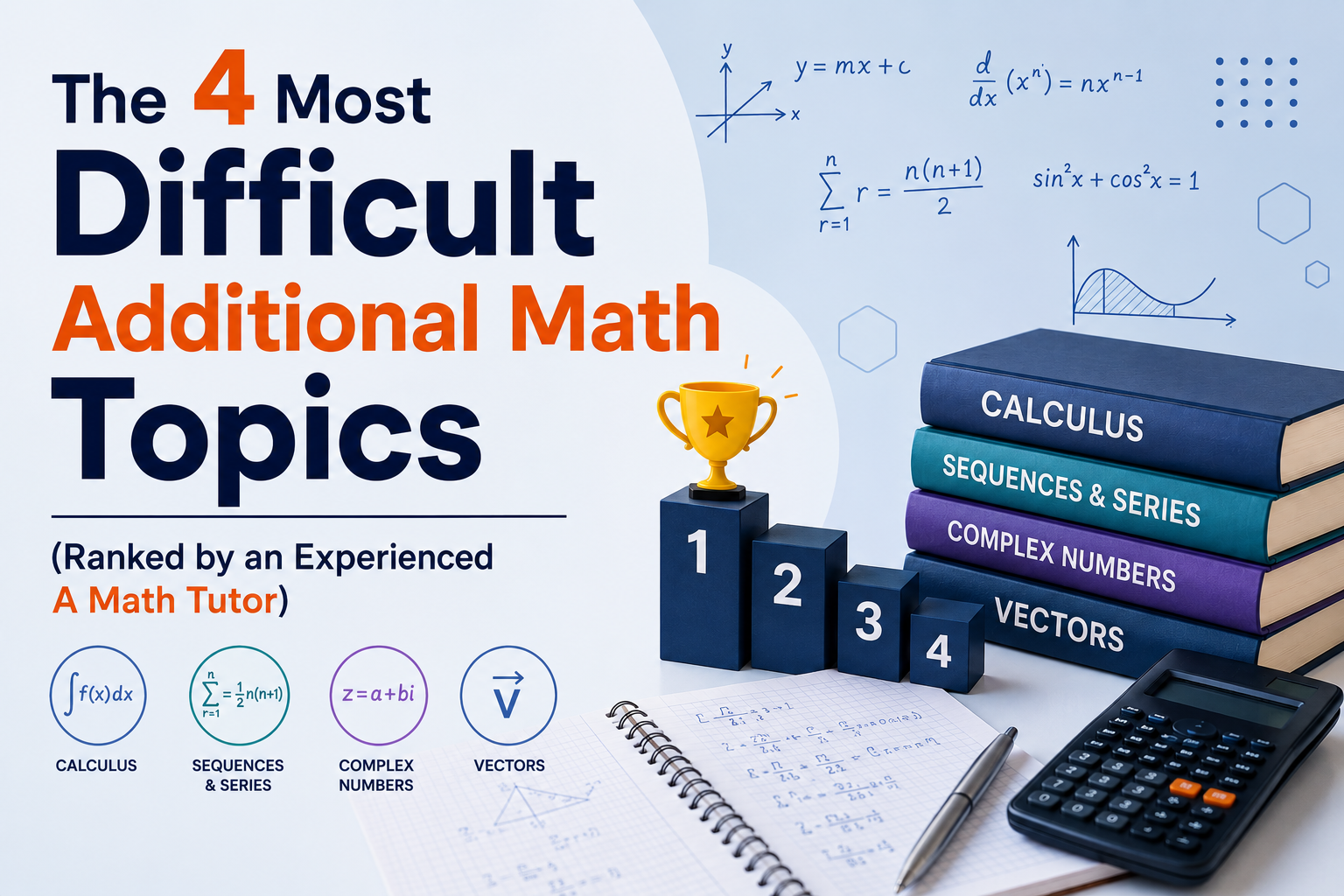
The 4 Most Difficult Additional Math Topics (Ranked by an Experienced A Math Tutor)
Additional Mathematics (A Math) has a reputation for being one of the most challenging subjects at the O Level. Every year, many Secondary 3 students who have been doing well in Elementary Mathematics suddenly find themselves struggling with unfamiliar concepts and more demanding problem-solving.
Unlike E Math, where many questions involve applying familiar techniques, A Math requires students to think more deeply, recognise patterns, connect different concepts, and manipulate algebra confidently. It is also much more abstract, which is why many students experience a steep learning curve in Secondary 3.
Having taught Additional Mathematics for more than 20 years, I have noticed that certain topics consistently pose the greatest challenge to students. Based on my experience coaching hundreds of students, here are what I consider to be the four most difficult A Math topics, ranked in increasing order of difficulty.
#4: Binomial Theorem
The Binomial Theorem enables students to expand powers of a two-term expression such as . Although the expansion formula is provided in the O Level examination formula sheet, this topic is far from straightforward.
Most examination questions go well beyond simple expansions. Instead of asking students to expand an expression with a fixed power, questions often involve an unknown power, requiring students to know how to simplify expressions like nC1, nC2, etc.
Another very common question type asks students to find only a particular term in the expansion instead of writing out the entire expansion. This requires a good understanding of the general term of the Binomial Expansion, a concept that many students initially find difficult.
Success in this topic also depends heavily on mastery of Indices, a topic learnt in both E Math and A Math. Incorrect application of the Laws of Indices often causes students to lose marks even when they understand the overall method. In other words, weak algebraic manipulation can easily become the stumbling block for Binomial Theorem.
#3: Logarithms
Logarithms are a natural continuation of the topic on Indices. Logarithms provide a language for working efficiently with exponents and exponential relationships.
Logarithms are one of those mathematical concepts that appear repeatedly in higher mathematics. They are fundamental in JC Mathematics, university mathematics, the sciences, economics, engineering and many other fields. Building a strong foundation here pays dividends for years to come.
Unfortunately, logarithms are also one of the most abstract topics introduced in Secondary 3.
Many stronger students memorise the logarithmic laws and become proficient through repeated practice. Interestingly, in my experience, only a very small percentage of students truly understand how these logarithmic properties are derived. Fortunately, at O Level, it is sufficient to understand when and how to apply them correctly.
Weaker students, however, often become overwhelmed by the various logarithmic laws. When faced with unfamiliar questions, they sometimes invent their own “rules”. One of the most common mistakes I see is students incorrectly believing that
Unfortunately, this property does not exist.
#2: Trigonometry
If I had to describe Trigonometry in one word, it would be massive.
Rather than being a single topic, Trigonometry is really a collection of several interconnected topics. Students have to learn:
-
Trigonometric identities (several)
-
Trigonometric equations
-
Trigonometric graphs
-
Radian measure
On top of these, students must already be comfortable with the E Math trigonometry topics involving the Sine Rule, Cosine Rule and area of triangles.
The amount of information alone can feel overwhelming.
Students need to remember numerous identities, understand when sine, cosine and tangent are positive or negative in different quadrants, and apply systematic procedures to solve trigonometric equations. Many solutions involve several careful algebraic steps, and a single careless mistake can affect the entire answer.
As if that were not enough, students are introduced to an entirely new unit for measuring angles: radians. Every graph, identity and equation must now be understood in both degrees and radians, effectively doubling the number of situations students need to be comfortable with.
It is therefore no surprise that Trigonometry remains one of the biggest hurdles for many Additional Mathematics students.
#1: Linear Law
In my opinion, the most difficult topic in Additional Mathematics is Linear Law.
Interestingly, the mathematics involved is not particularly advanced. What makes this topic difficult is that students have to change the way they think.
Linear Law teaches students how to convert a non-linear relationship into a straight-line relationship by redefining the variables. Once the equation has been transformed, students can draw a straight-line graph and determine quantities such as the gradient and intercept.
This technique is extremely useful in analysing experimental data in science and engineering, where many relationships are naturally non-linear.
The challenge is that students are effectively working with two different systems simultaneously.
The original equation involves variables such as (x) and (y).
The transformed equation involves entirely new variables such as (X) and (Y).
Students must understand that these represent two different “worlds”. Before moving from one world to the other, they must first transform the variables correctly. If they fail to appreciate this fundamental idea and instead treat everything as one single system, the entire topic becomes confusing.
To make matters more challenging, many Linear Law questions require students to apply Logarithms during the transformation process. This effectively combines two difficult topics into one, making Linear Law the most conceptually demanding topic in the Additional Mathematics syllabus.
Why Secondary 3 Feels So Difficult
One interesting observation is that all four of these topics are taught in Secondary 3, not Secondary 4.
So what do students learn in Secondary 4?
Much of the year focuses on Differentiation and Integration. Surprisingly, although these topics sound intimidating, many students actually find them more intuitive than the abstract concepts introduced in Secondary 3.
This explains why it is common for students to struggle badly in Secondary 3, only to regain confidence in Secondary 4 before revisiting the earlier topics with greater maturity.
So parents, if your Secondary 3 child tells you that Additional Mathematics is hard, believe them. The struggle is very real.
At this stage, students are not only learning new techniques. They are also developing the mathematical maturity needed to handle abstract thinking. This takes time, patience and careful guidance.
How Debbie’s Learning Cove Helps Students Master Additional Mathematics
At Debbie’s Learning Cove, I have spent more than two decades helping students overcome these exact difficulties. Because I know where students typically struggle, I can guide them through each topic with confidence.
My lessons are carefully designed to help students build genuine understanding instead of simply memorising methods.
Students benefit from:
-
Carefully structured notes that break difficult concepts into bite-sized, manageable pieces.
-
Clear explanations that uncover the reasoning behind each concept.
-
Explicit discussion of common misconceptions and examination mistakes.
-
Memorable acronyms, analogies and actions that help students remember properties, and procedures.
-
Summary sheets that put everything they need to know on one piece of paper.
-
Step-by-step coaching through challenging examination questions, demonstrating not only how to solve them, but also how to think like a mathematician.
With the right guidance, even the most difficult Additional Mathematics topics can become easy, and many students eventually discover that A Math becomes one of their strongest subjects.
Summary
Additional Mathematics is undoubtedly a challenging subject, especially in Secondary 3 when students encounter several highly abstract topics in quick succession.
In my experience, the four most difficult topics are:
-
Linear Law
-
Trigonometry
-
Logarithms
-
Binomial Theorem
Every student struggles differently, but with patient guidance, consistent practice and a clear understanding of the underlying concepts, these topics become far less intimidating.
The goal is not simply to survive A Math, but to develop the confidence and mathematical thinking that will benefit students far beyond the O Level examinations.