





Additional Math Tuition Singapore: Achieve Success in O-Level & SEC A Math

We Make Additional Mathematics Easy to Understand

Looking for Additional Math Tuition that combines clear teaching, structured lessons and personal guidance?

At Debbie’s Learning Cove, students receive expert O-Level and SEC Additional Math tuition personally taught by Mrs Debbie Wong. Through clear explanations, carefully designed learning materials and proven problem-solving strategies, students develop the confidence and understanding needed to excel in Additional Mathematics.

Whether your child is struggling to keep up or aiming for an A1 distinction, every lesson is designed to help students understand concepts deeply, solve problems confidently and achieve their fullest potential.

25+ Years

Teaching Experience

4–12

Students Per Class

Cambridge

1st Class Honours + MA

2+ Grades

Avg. Improvement

Why Debbie’s Learning Cove Is the One of the Best Additional Math Tuition in Singapore

What makes us different?

  • Every lesson is personally taught by Mrs Debbie Wong.
  • More than 25 years of specialised Mathematics teaching experience.
  • Cambridge First Class Honours graduate in Mathematics.
  • Small classes averaging just 4 to 12 students.
  • Carefully crafted notes and worksheets developed over decades.
  • Clear explanations that focus on understanding, not memorisation.
  • Personal guidance and individual feedback during every lesson.
  • WhatsApp support outside lesson time for academic questions.
  • Proven track record of students improving by two grades or more.
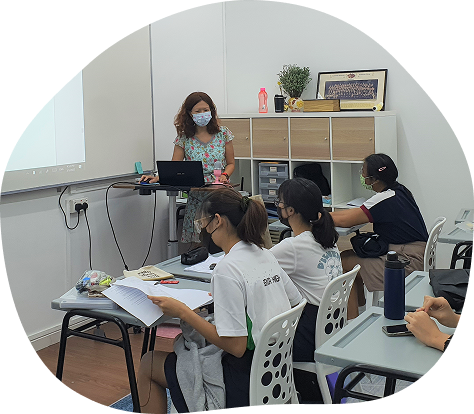
Mrs Debbie Wong teaching a small Additional Math class

Our philosophy is simple.

Students should never memorise Mathematics without understanding it.

Developing this strong conceptual foundation not only helps students excel in O-Level and SEC Additional Mathematics, but also prepares them well for H2 Mathematics in junior college.

Why Do Secondary Students Find Additional Mathematics So Difficult?

For many students, Additional Mathematics is the biggest academic jump they experience in secondary school.

Compared with Elementary Mathematics, the subject demands much more than applying formulas.

Students must learn to:

  • Connect different mathematical concepts
  • Reason logically through multi-step questions
  • Recognise patterns and relationships
  • Apply concepts to unfamiliar situations
  • Solve problems efficiently under examination conditions

Without a strong conceptual foundation, many students gradually lose confidence and begin relying on memorised methods that often fail when questions become unfamiliar.

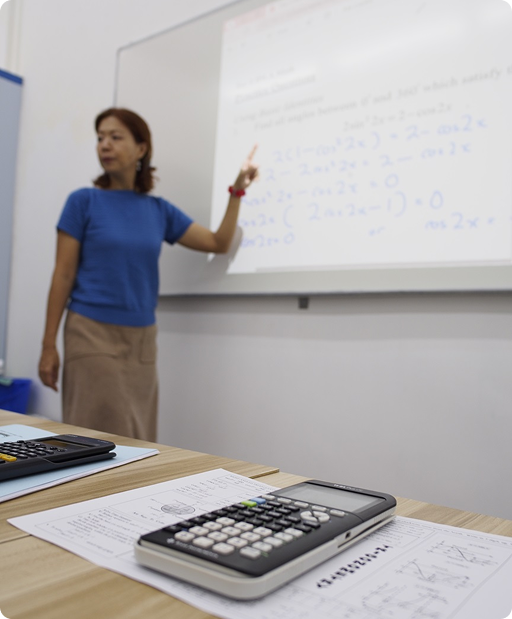
Mrs Debbie Wong teaching Additional Mathematics at the whiteboard

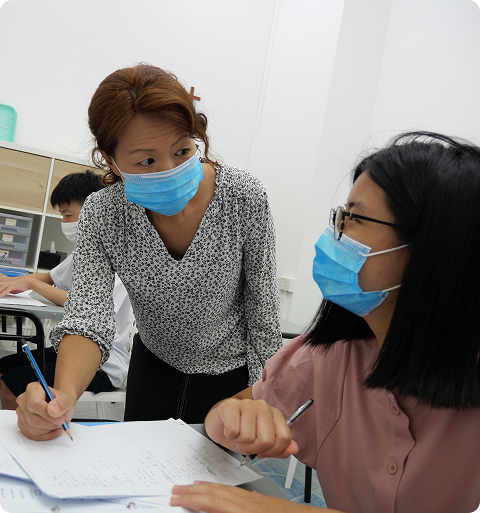
Mrs Debbie Wong guiding a student through Additional Math problems

Turning Additional Mathematics from Challenging to Fun

At Debbie’s Learning Cove, students learn to think mathematically.

Rather than rushing through formulas and procedures, Mrs Debbie Wong carefully builds each topic from first principles before introducing efficient problem-solving techniques.

Difficult ideas are broken into smaller, manageable steps that students can understand and remember.

Lessons are lively and engaging through the use of:

  • Memorable acronyms
  • Simple visual techniques
  • Easy-to-remember actions
  • Humour
  • Real classroom examples

These teaching methods make lessons enjoyable while helping students retain concepts far more effectively.

Over time, many students discover that Additional Mathematics is no longer intimidating. Instead, it becomes one of the subjects they enjoy most.

Meet Mrs Debbie Wong – Your Additional Math Tuition Specialist

  • Over 25 years of experience teaching Additional Mathematics, Integrated Programme (IP) Mathematics and A-Level Mathematics in Singapore.
  • First Class Honours and Master of Arts in Mathematics, University of Cambridge.
  • Recipient of the prestigious Overseas Singapore Government Teaching Scholarship awarded by the Public Service Commission.

Teaching Experience

  • Former Level Head of Mathematics, Temasek Secondary School – Taught E Math and A Math from Secondary 1 to Secondary 5, while mentoring and supervising Mathematics teachers.
  • Former IP Mathematics Teacher, Temasek Junior College – Taught Intermediate Mathematics and Advanced Mathematics to Integrated Programme students.
  • Former Lecturer and Tutor, Hwa Chong Junior College – Taught A-Level Mathematics, Further Mathematics and Mathematics Special Paper.

Academic Achievements

  • Best Overall Student in JC1 and JC2.
  • Best in Cohort for JC Mathematics.
  • Distinctions in A-Level Further Mathematics and Mathematics Special Paper.
Mrs Debbie Wong, Additional Math Tuition Specialist

The Student’s Success Is Our Success

Nothing is more rewarding than seeing students transform from struggling with Mathematics to becoming confident, independent learners. Many students tell us that concepts finally “click” during lessons because they are explained clearly and logically. As their understanding grows, so does their confidence.

Over the years, many students have:

  • Improved by two grades or more
  • Progressed from failing grades to distinctions
  • Become the top Mathematics student in their cohort
  • Entered their preferred junior colleges
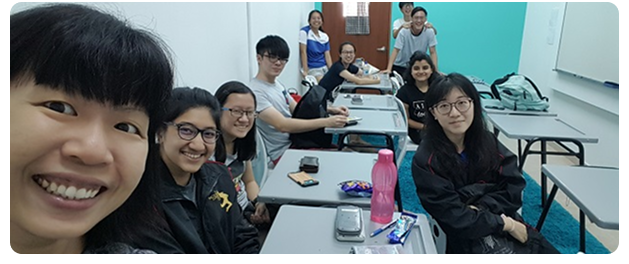
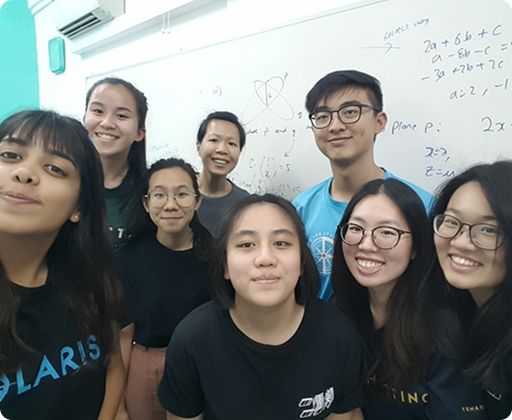
Students celebrating together in class

What Students Receive

Every student enrolled in our Additional Math Tuition Singapore programme benefits from a carefully designed learning system developed over more than 25 years of teaching experience.

Students receive:

  • Weekly 2-hour lessons personally taught by Mrs Debbie Wong
  • Small classes averaging only 4 to 12 students for closer individual attention
  • Carefully crafted lesson notes that explain concepts clearly and concisely
  • Challenging worksheets that prepare students for a wide variety of examination questions
  • Topic summaries that make revision faster and more effective
  • Individual guidance and personalised feedback during lessons
  • WhatsApp support for Mathematics questions outside lesson time
  • Systematic revision leading up to the O-Level and SEC examinations
Mrs Debbie Wong giving individual guidance to a student

A Conducive Learning Environment for Success

Students learn in small classes averaging 4 to 12 students, allowing Mrs Debbie Wong to provide close attention and personalised guidance throughout every lesson.
Students are encouraged to ask questions freely in a supportive and engaging environment.

Every lesson follows a carefully structured approach:

Clear Teaching icon

Clear Teaching

New concepts are introduced through simple explanations and carefully chosen examples, so students first understand the underlying ideas before tackling more challenging questions.

Guided Practice icon

Guided Practice

Students work through progressively more demanding questions while receiving immediate feedback and personalised guidance.

Reinforcement icon

Reinforcement

Every topic is supported by concise notes and thoughtfully designed worksheets that strengthen understanding and prepare students for examination success.
This structured approach helps students build genuine mastery instead of relying on memorisation.

Preparing Students for O-Level & SEC Additional Mathematics

Students who successfully completed O-Level and SEC Additional Mathematics preparation

Success in O-Level and SEC Additional Mathematics requires much more than finishing the syllabus.
As the national examinations approach, lessons become increasingly focused on examination preparation.

Students benefit from:

  • Systematic topical revision
  • Reinforcement of key concepts
  • Correction of common misconceptions
  • Intensive practice across a wide variety of question types
  • Exposure to non-routine and higher-order problems
  • Concise topic summaries for efficient revision

Learn Onsite or Online

At Debbie’s Learning Cove, every lesson is conducted simultaneously both onsite and live via Zoom, allowing students to learn in the way that suits them best.

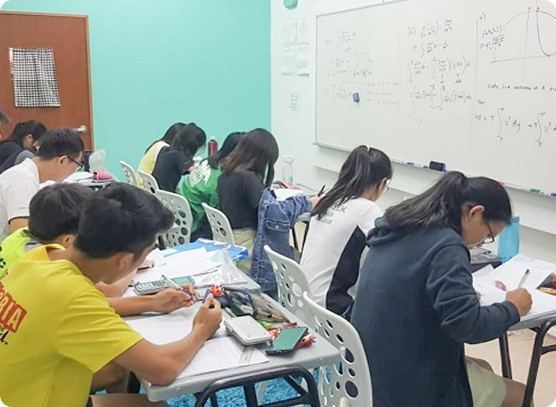
Students attending onsite lessons at Roxy Square

Onsite Lessons

Students attending our centre at Roxy Square enjoy:

  • Comfortable air-conditioned classrooms
  • Full-sized desks and chairs
  • An engaging classroom atmosphere
  • Opportunities to interact directly with Mrs Debbie Wong

Online Lessons

Students joining from home receive exactly the same:

  • Live lesson
  • Teaching
  • Lesson materials
  • Explanations
  • Opportunities to ask questions

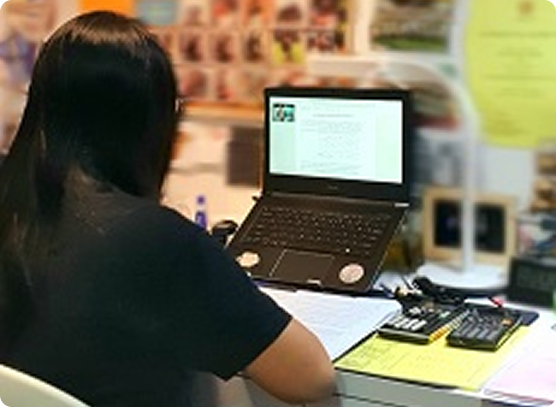
Student attending an online lesson via Zoom

Lesson Timetable & Fees

Class Day & Time Fees
Secondary 3 G3 Additional Mathematics (2026) Saturday 3:30 pm to 5:30 pm $340 per four lessons
Secondary 4 O-Level Additional Mathematics (2026) Saturday 1:00 pm to 3:00 pm $360 per four lessons

Registration & Administrative Information

  • One-time registration fee: $30
  • Monthly fees are pro-rated according to the number of lessons.
  • Onsite students pay a material fee of $30 per semester (excluding the semester of enrolment).
  • No material fee is charged for online students.
  • Trial lessons are charged at the single-lesson rate.
  • A $5 material fee applies for onsite trial lessons.

Frequently Asked Questions

Our Additional Math Tuition Singapore programme is suitable for students with a wide range of learning needs.
Whether your child:

  • is struggling to understand Additional Mathematics in school
  • hopes to improve from a passing grade to a distinction
  • is already performing well but wants to secure an A1
  • plans to study H2 Mathematics in junior college

our lessons are designed to build strong conceptual understanding and long-term confidence.
Students are expected to attend lessons regularly, complete homework and participate actively in class. Consistent effort, together with expert guidance, leads to the greatest improvement.

Absolutely.

Although students entering junior college from 2028 will be assessed using the new L1R4 system instead of L1R5, Additional Mathematics is the foundation for H2 Mathematics.

Beyond preparing students for national examinations, the subject develops:

  • algebraic fluency 
  • logical reasoning 
  • analytical thinking 
  • advanced problem-solving skills 

These skills become invaluable for students intending to study Mathematics, Science, Computing, Engineering, Economics and many other university courses.

In addition, because every counted subject now carries greater weight under L1R4, performing well in Additional Mathematics can make a meaningful difference to a student’s overall aggregate.

For most students, Secondary 3 is the ideal time to begin tuition.

Additional Mathematics introduces many completely new concepts, and students who build a strong foundation early often find later topics much easier to understand.

Starting in Secondary 4 is still beneficial, particularly if your child is prepared to work consistently. However, students who begin earlier generally experience less stress and have more time to develop confidence before the O-Level or SEC examinations.

Our lessons focus on the full Additional Mathematics syllabus.

However, selected Elementary Mathematics topics that overlap with Additional Mathematics are also covered where relevant. 

Although E Math and A Math are separate subjects, students frequently discover that the stronger algebraic skills and mathematical thinking developed during Additional Math lessons also improve their confidence and performance in E Math.

Yes.

Every student receives carefully developed learning materials that have been refined over decades of teaching experience.

Students receive:

  • comprehensive lesson notes 
  • carefully designed worksheets 
  • challenging practice questions 
  • concise topic summaries for revision 

Our materials are designed not simply to explain concepts clearly, but also to expose students to the wide variety of question types commonly tested in O-Level and SEC Additional Mathematics examinations.

Many students tell us these resources become one of their most valuable revision tools throughout Secondary 3 and Secondary 4.

Both options provide exactly the same:

  • teaching 
  • lesson materials 
  • explanations 
  • opportunities to ask questions 

Students who enjoy the classroom environment and benefit from closer supervision often prefer onsite lessons.

Students who are disciplined, independent learners may prefer the flexibility of attending live online lessons from home.

Ultimately, the best option depends on your child’s learning style, and students can switch between onsite and online whenever necessary.

Students are welcome to contact Mrs Debbie Wong through WhatsApp whenever they encounter difficulties.

Questions may come from:

  • school tutorials 
  • homework 
  • revision exercises 
  • past-year examination papers 

The aim is simple: students should never remain stuck on a question for long. Prompt guidance helps maintain confidence and ensures steady progress throughout the year.

    Enquiry


    Roxy Square, #02-72, 50 East Coast Road, S428769


    debbielearningcove@gmail.com


    +65 96865169 (Text/WhatsApp only. Do not call)

    What Parents and Students Say

    Qi En (2022 O-Level A1)

    Mrs Wong is incredibly patient and explains Mathematics concepts with exceptional clarity. Her notes are concise, well organised and helped me see the connections between different topics. I improved from a B3 to an A1 for O-Level Additional Mathematics and became much more confident. I continued with Mrs Wong for H2 Mathematics and eventually scored an A at A Levels.

    Mayah (2025 O-Level A2)

    I joined after scoring a C5 for my Sec 3 End-of-Year Examination. Within one semester, my Additional Mathematics improved to an A1. Mrs Wong explains every topic thoroughly and is always willing to help, whether during lessons or through WhatsApp. She genuinely cares about every student’s progress.

    Loh LT (Parent Testimonial)

    My daughter studied with Mrs Debbie Wong for just over a year, and we saw a remarkable transformation from a C-grade student to achieving an A at O Levels. Even topics she had struggled with earlier were eventually mastered through the systematic revision programme. We are truly grateful for Mrs Wong’s dedication and patience.

    Blogs

    Ten Proven Tips to Excel in Additional Math

    December 8,2025

    Ten Proven Tips to Excel in Additional Math

    Debbie Wong, Founder and Teacher, Debbie’s Learning Cove 

    Additional Mathematics (A Math) is a subject taken by many upper secondary and IP students. It is essential for those planning to study mathematics at a higher level in tertiary education.

    Moving from Secondary 2 to Secondary 3 can be a big adjustment. Concepts become more abstract, questions are longer and more challenging, and exams can be intimidating.

    It is no surprise that the cohort average Secondary 3 A Math exam score is below 50% in many schools.

    So, how can you do well in A Math? Here are ten practical tips to help you succeed.

    Ten Tips to Excel in Additional Math

    1) Strengthen your lower secondary math foundation

    A strong foundation from lower secondary math is crucial for success in A Math. If you scored 85% or higher, you already have a solid base to build on. If your score was below 85%, there may be gaps or misconceptions that need attention before tackling A Math.

    Spend time revising important topics, particularly algebra and graphs, as they are essential for understanding A Math concepts. Joining a group A Math tuition class can also help identify and address any foundational gaps, giving you confidence as you move forward.

    Join A Math Tuition Class

    2) Take A Math seriously from the start

    Many students make the mistake of not taking A Math seriously until it is too late. This often leads to gaps in understanding that are difficult to close later. By paying attention from the first lesson, revising regularly, and completing all homework diligently, you set yourself up for consistent progress throughout the year. Building these good habits early will make the subject feel more manageable and less stressful.

    3) Understand concepts before practicing

    Practicing without a clear understanding of the concepts can lead to repeated mistakes and confusion. For example, why is it that when a quadratic expression is always positive, the discriminant of the quadratic equation is negative? Fully grasping the reasoning behind each concept ensures you can apply it correctly and confidently.

    Always take the time to understand the “why” behind concepts and methods. If a concept is unclear, ask your teacher or a tutor for help, as extra guidance can make a significant difference.

    4) Practice after you understand the topic

    Once you understand a concept, practising questions is the next step. Doing a variety of questions allows you to reinforce your learning and spot mistakes early. Ensure your practice covers all aspects of the topic, including the more challenging questions. Reviewing your solutions carefully and learning from errors is essential to solidifying your understanding. This structured practice builds both confidence and competence.

    5) Improve your speed

    Accuracy is essential in math, but speed is equally important. Exams have time limits, so you need to work efficiently without sacrificing correctness. Practice under timed conditions to train your mind to think quickly and your hands to write faster.

    Over time, this will help you manage exam pressure and leave sufficient time to check your answers thoroughly.

    6) Develop strategies to avoid careless mistakes

    Careless mistakes can be frustrating, but they can be minimised with the right strategies. Always consider ways to double-check your work, such as substituting answers back into the original equation or solving a problem using a different method.

    Some topics also have quick checks, like substituting numbers into partial fractions to verify accuracy. Working with an experienced A math tutor can help you learn these strategies and improve both your accuracy and confidence in exams.

    7) Learn from every mistake

    Every mistake is an opportunity to learn. Simply copying a teacher’s solution without understanding the error will allow misconceptions to persist. Take the time to identify exactly where you went wrong, correct it, and ensure you understand it fully.

    This habit of reflecting on and learning from mistakes is essential for long-term improvement and for building a deep understanding of math concepts.

    8) Practice by topics first, then by papers

    After mastering individual topics, start practicing past exam papers. This helps you recognize which topic a question belongs to and apply the correct concept. Simulating exam conditions by setting time limits, avoiding notes, and only checking answers afterward builds both confidence and time management skills. Practicing in this way also helps you become familiar with the style and patterns of exam questions.

    9) Set high goals for yourself

    A Math is a subject where you can aim for full marks, and setting high goals can motivate you to do your best. Unlike subjective subjects, math allows you to track tangible progress and improvement.

    I have coached students who barely passed Secondary 2 Math but scored above 90% in A Math with consistent effort and the right attitude. Don’t settle for just passing. Aim high, work hard, and challenge yourself to achieve the results you are capable of.

    10) Teach your friends

    Teaching others is a powerful way to reinforce your own understanding. I remember when I explained differentiation to my classmates, I retained the topic effortlessly for exams.

    Teaching forces you to verbalize concepts clearly and defend your understanding, which strengthens your memory. Arrange study sessions outside class so you don’t miss lessons while still helping your friends, creating a win-win situation for everyone.

    Conclusion

    Excelling in Additional Math is not about natural talent. It is about consistent effort, structured practice, and a proactive mindset. Strengthen your foundation, understand concepts deeply, practice strategically, and learn from mistakes. With dedication and focus, challenges can be transformed into achievements, and you can enjoy the satisfaction of mastering mathematics.

    FAQ

    Q: How long should I practice A Math daily? A: Aim for 1-2 hours on school days, and longer sessions during holidays. Consistency is more important than long, irregular bursts.

    Q: Should I join a tuition class or self-study? A: Both options work, but an A Math tuition class can help identify gaps, provide structured guidance, and teach strategies you might not discover on your own.

    Q: What if I struggle with a topic repeatedly? A: Focus on fully understanding the concept, ask for help when needed, and try teaching the topic to someone else to reinforce your learning.

    Q: How can I avoid careless mistakes in exams? A: Develop strategies for checking your work, practice under timed conditions, and train yourself to work efficiently without sacrificing accuracy.

    Q: Is practicing past papers necessary? A: Absolutely. Past papers help you apply concepts under exam conditions, manage time, and become familiar with the patterns and style of exam questions.

    Read More